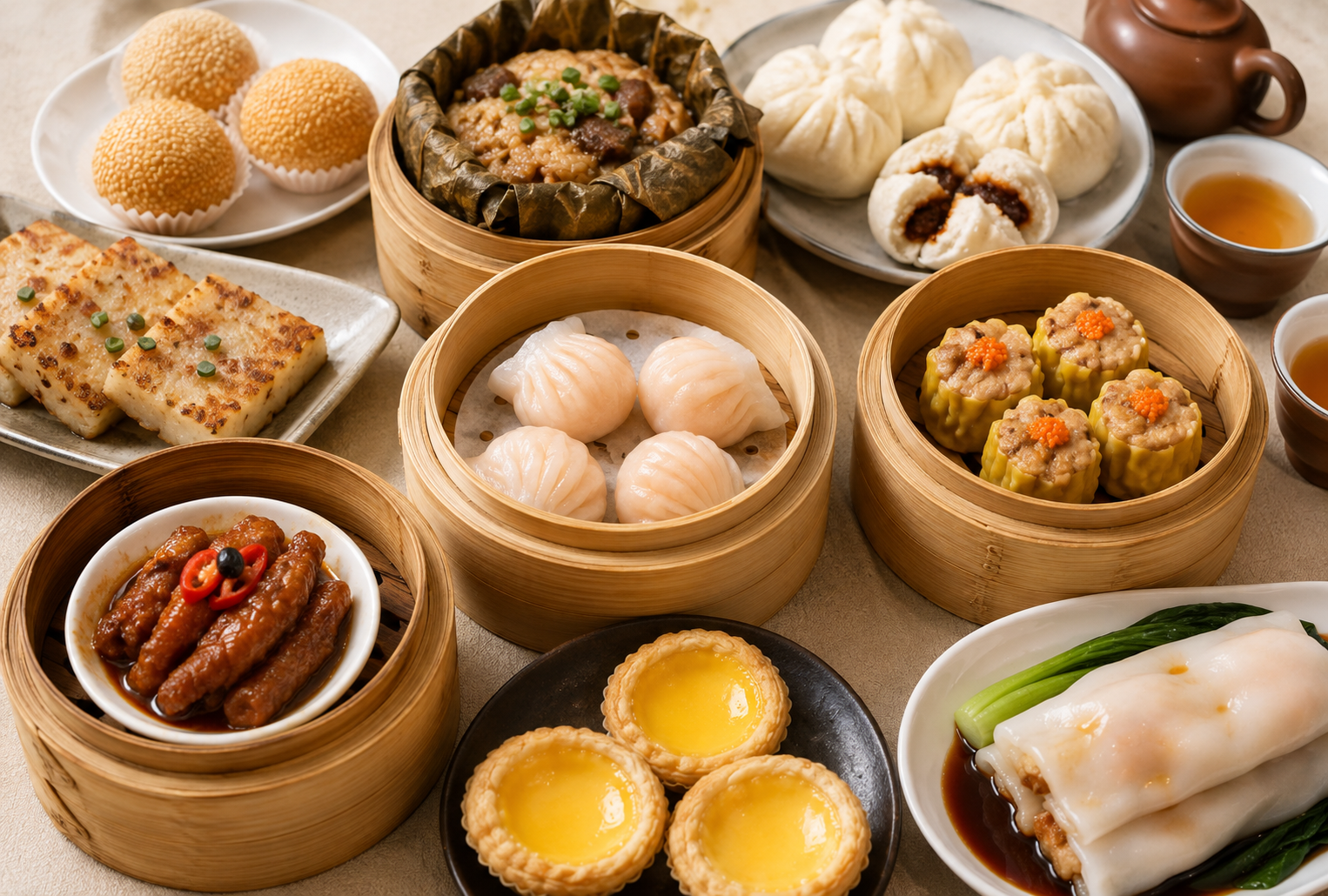
If you've ever looked at a dim sum menu and wondered where to start, you're not alone. With bamboo steamers filled with dumplings, fluffy steamed buns, rice noodle rolls, crispy appetizers, savory specialties, and sweet treats, a first dim sum experience can feel a little overwhelming.
The good news is that you don't need to know every dish before your first meal. Dim sum is meant to be explored, shared, and enjoyed one small dish at a time. Instead of ordering one large entrée, diners typically choose several smaller dishes and share them around the table.
That makes dim sum a great introduction to Cantonese cuisine. You can begin with familiar flavors, try a few traditional favorites, and gradually work your way toward dishes you've never experienced before.
And today, you don't necessarily need to visit a restaurant in person to start exploring. Many Asian restaurants offer dim sum favorites for online ordering, allowing you to browse the menu at your own pace and build an assortment to enjoy at home.
If you're new to dim sum, this guide will help you understand the most popular dishes, what they taste like, how much to order, and what to look for when you're ready to place your first order.
What Is Dim Sum?
Dim sum is a broad category of small Cantonese dishes traditionally enjoyed with Chinese tea. Rather than referring to one specific type of food, dim sum encompasses a wide range of steamed, baked, pan-fried, and fried dishes.
Depending on the restaurant, a dim sum menu may include shrimp dumplings, pork dumplings, steamed buns, rice noodle rolls, sticky rice, savory pastries, vegetables, meats, soups, and desserts.
Dim sum is closely connected to yum cha, the Cantonese tradition of drinking tea while enjoying small dishes. The experience is traditionally social, with family and friends gathering around a table and sharing a variety of foods.
That emphasis on sharing is one of the things that makes dim sum different from a typical restaurant meal. Rather than choosing one entrée for yourself, everyone can select several dishes and taste a little of everything.
For beginners, this makes dim sum particularly approachable. You don't have to know which dish is your favorite before you start. You can order a few classics, discover what you enjoy, and try something new the next time.
If you're interested in learning more about Chinese cuisine in general, you can also explore Springroll's guide to 6 Regional Chinese Cuisines You Should Know, which can help you understand how Cantonese food fits into the larger world of Chinese cooking.
How Does Dim Sum Ordering Work?
The traditional dim sum experience can vary depending on the restaurant.
At some restaurants, servers walk around the dining room with carts or trays of freshly prepared dishes. Diners can see what's available and choose what looks appealing. Other restaurants use printed menus or checklists where customers select the dishes they want.
Today, many restaurants also make their menus available online.
Online ordering can be particularly useful when you're trying dim sum for the first time. Instead of feeling rushed while deciding what to order, you can browse the menu, read the names, pictures and descriptions, compare different dishes, and build your order before checking out.
Through Springroll, customers can discover participating Asian restaurants, browse their menus, and order online for pickup or delivery where available.
Whether you're dining at a restaurant or ordering dim sum to enjoy at home, the same basic strategy works well: start with a few different dishes rather than ordering too much of one thing.
Because dim sum is traditionally served in smaller portions, variety is part of the experience.
What Should You Order on Your First Dim Sum Visit?
If you're completely new to dim sum, start with some of the most recognizable dishes. Once you've tried a few classics, you can branch out into more adventurous options.
A well-rounded first order should include different flavors and textures. For example, you might choose a couple of steamed dumplings, a soft bun, a rice-based dish, something crispy, and a sweet treat.
Here are some of the most popular dim sum dishes worth looking for.
Har Gow: Steamed Shrimp Dumplings
Har gow is one of the most recognizable dim sum dishes and an excellent starting point for beginners.
These steamed shrimp dumplings are known for their delicate, translucent wrappers. The filling typically consists of shrimp with subtle seasonings, and some versions include ingredients such as bamboo shoots for additional texture.
The wrapper is soft and slightly chewy, while the shrimp filling is tender and flavorful.
Har gow is especially approachable if you already enjoy shrimp or seafood. The flavor is generally mild, making it a good first step into dim sum if you're unsure about trying unfamiliar dishes.
When browsing an online menu, look for names such as har gow, shrimp dumplings, or steamed shrimp dumplings. Restaurants may use slightly different names for the same or similar dish.
Siu Mai: The Open-Top Dumpling
Siu mai, also spelled shumai or shu mai, is another dim sum classic.
Unlike har gow, which is enclosed in a translucent wrapper, siu mai has an open top that exposes the filling. Traditional versions commonly feature pork and shrimp, although ingredients can vary from one restaurant to another.
Siu mai is another excellent choice for first-time diners because the flavor is savory and familiar without being particularly complicated.
If you're ordering har gow, adding siu mai gives you two classic steamed dumplings with different textures and flavors.
BBQ Pork Buns: Soft, Savory and Slightly Sweet
Dim sum isn't all about dumplings.
BBQ pork buns, commonly called char siu bao, are fluffy steamed buns filled with Cantonese-style roasted BBQ pork. The bun is slightly sweet and soft, while the filling has a savory, smoky flavor.
For first-time diners, BBQ pork buns can be one of the easiest dishes to enjoy. If you're not sure about dumplings or seafood, the combination of soft bread-like dough and barbecue pork provides a familiar starting point.
Some restaurants also serve baked BBQ pork buns, which have a lightly browned exterior and a different texture from the traditional steamed version.
If you're sharing dim sum with a group, BBQ pork buns are a good way to add variety without ordering another type of dumpling.
Rice Noodle Rolls: A Different Kind of Dim Sum
Rice noodle rolls are an excellent choice when you want to move beyond dumplings.
Known as cheung fun in Cantonese, rice noodle rolls consist of soft, silky sheets of rice noodle wrapped around fillings such as shrimp, beef, pork, or vegetables. They are generally served with a savory sauce.
The texture is what makes them stand out. Instead of the chewy wrapper of a dumpling, rice noodle rolls are smooth, tender, and delicate.
If you enjoy noodles or want to try something that feels completely different from steamed dumplings, this is a dish worth adding to your order.
When browsing a menu, you may see names such as rice noodle roll, shrimp rice noodle roll, beef rice noodle roll, or cheung fun.
Turnip Cake: A Savory Classic
Don't let the name fool you. Turnip cake is not a sweet dessert.
Traditionally known as lo bak go, turnip cake is made primarily with shredded daikon radish and rice flour. Depending on the recipe, it may also include ingredients such as Chinese sausage, dried shrimp, or other savory additions.
The mixture is steamed and then often pan-fried, giving the outside a lightly crisp texture while the inside remains soft.
Turnip cake is a good choice once you're ready to explore beyond dumplings and buns. Its combination of crisp edges and a tender center gives you another interesting texture to add to your meal.
Not every restaurant offers turnip cake, so don't worry if you don't see it on the menu. Dim sum selections can vary significantly from restaurant to restaurant.
Sticky Rice: A Hearty Dim Sum Favorite
Another dish worth trying is sticky rice, often called lo mai gai.
This Cantonese specialty typically combines glutinous rice with ingredients such as chicken, mushrooms, and seasonings. The mixture is traditionally wrapped in a lotus leaf and steamed.
The result is a flavorful and filling dish with a soft, sticky texture.
Sticky rice is particularly good for sharing because it adds something more substantial to a table filled with smaller dumplings and buns.
If you're ordering a larger meal, adding a rice-based dish can also help make the assortment more filling.
Congee: A Comforting Addition
Congee is a type of rice porridge that is widely enjoyed throughout Chinese cuisine and is often found on Cantonese restaurant menus.
It can be served simply or with ingredients such as pork, seafood, chicken, vegetables, or century egg.
Congee has a soft, comforting texture and can provide a nice contrast to crispy or fried dim sum dishes.
It can also be a good choice if you're ordering for someone who prefers milder or softer foods.
Try Something Fried or Crispy
Steamed dumplings may be the stars of a dim sum meal, but fried and pan-fried dishes are worth exploring too.
Depending on the restaurant, you might find fried shrimp rolls, fried dumplings, spring rolls, sesame balls, or pan-fried pot stickers.
Adding one crispy dish to your order creates a better balance of textures. If the rest of your meal consists mostly of soft steamed dumplings and buns, something golden and crunchy can provide a welcome contrast.
When ordering for a group, this is also a simple way to add variety without having to choose another unfamiliar dish.
Don't Forget the Tea
Tea is an important part of the traditional dim sum experience.
Common choices include jasmine tea, oolong, pu-erh, and chrysanthemum tea. Each has its own aroma and flavor, so you can choose based on what sounds appealing or simply try the restaurant's recommendation.
Jasmine tea is floral and fragrant, while oolong can have a deeper and more complex flavor. Pu-erh is generally richer and earthier.
Tea also works well alongside dim sum because it provides a refreshing contrast to savory, fried, and richer dishes.
If you're ordering dim sum online to enjoy at home, you can recreate part of the experience by preparing your favorite Chinese tea alongside your meal.
Save Room for Something Sweet
Dim sum isn't limited to savory dishes.
Many restaurants offer sweet treats that can be enjoyed at the end of the meal. Two classics worth looking for are sesame balls and egg custard tarts.
Sesame balls are made from glutinous rice flour and coated with sesame seeds. They are often filled with sweet red bean paste and have a pleasantly chewy texture.
Egg custard tarts feature a flaky pastry shell filled with smooth, lightly sweet egg custard.
Depending on the restaurant, you may also find sweet buns, mango pudding, coconut desserts, or other sweets.
If you're sharing with a group, ordering one or two desserts for the table is usually enough to give everyone a taste.
How Much Dim Sum Should You Order?
One of the most common questions for first-time diners is how much food to order.
There's an old Cantonese saying, 一盅两件 (yat jung leung gin), which translates to "one pot of tea and two dishes." It reflects the traditional, unhurried spirit of dim sum, where the point was never to order a huge spread, but to sit, sip tea, and enjoy a couple of dishes at a time before deciding what to try next.
You can use that same philosophy for your first visit. Start small, with just a few dishes, and add more as you go rather than ordering everything up front. Because dim sum portions are typically small, four to six different dishes is usually plenty for two people, depending on portion size and appetite. Larger groups can simply order more and explore a wider selection.
Try not to order several dishes that are too similar. Instead of choosing four different types of steamed dumplings, for example, you might pick har gow, siu mai, BBQ pork buns, and rice noodle rolls, then add one fried dish and a dessert.
This approach gives you a better introduction to the range of textures and flavors dim sum has to offer, while staying true to the relaxed, one-dish-at-a-time spirit the tradition was built on.
How to Order Dim Sum Online
If you're ordering dim sum online for the first time, take advantage of the menu categories.
Start by looking for a dedicated Dim Sum section. From there, look for familiar dishes such as shrimp dumplings, siu mai, BBQ pork buns, rice noodle rolls, or sesame balls.
If the restaurant has separate sections for buns, fried items, rice crepes, or desserts, explore those as well. This can make it easier to create a balanced order.
Reading the menu before ordering also gives you time to look up unfamiliar dishes if necessary. You can decide what sounds appealing without feeling pressured to make a quick decision.
With Springroll, you can browse participating Asian restaurants online, explore their menus, and place an order from restaurants offering online ordering.
Where to Order Dim Sum Online
Once you know what to look for, the next step is finding a restaurant where you can try it.
Springroll connects customers with participating Asian restaurants, making it easy to browse menus and order online. Here are five restaurants offering dim sum that you can explore:
Ming Garden - Orlando
If you're in Orlando, Ming Garden offers an extensive dim sum selection with a variety of classic dishes. Its menu includes shrimp dumplings, siu mai, steamed roast pork buns, rice rolls, turnip pudding, sticky rice, fried dumplings, sesame balls, and other specialties.
With a broad selection to choose from, it's easy to build a varied order and try several different types of dim sum in one meal.
Browse Ming Garden's Dim Sum Menu & Order Online
S & R Dim Sum - Jacksonville
In Jacksonville, S & R Dim Sum offers a dedicated dim sum menu with a variety of steamed, fried, and sweet options.
It's a good option if you're looking for a restaurant where dim sum is a central part of the menu and you want to explore several different dishes in one order.
Browse S & R Dim Sum's Menu & Order Online
Ying Dim Sum - Aurora
For diners in Aurora, Ying Dim Sum offers a menu organized around several different dim sum categories, including rice crepes, traditional dim sum, steamed buns, fried specialties, soup, and drinks.
Options such as shrimp dumplings, siu mai, BBQ pork buns, sticky rice with chicken and mushroom, fried shrimp rolls, and sesame balls make it easy to create a first-time order with different flavors and textures.
Browse Ying Dim Sum's Menu & Order Online
Tao's Bao & Dim Sum - Stony Brook
In Stony Brook, Tao's Bao & Dim Sum offers dim sum and bao alongside dumplings, noodles, congee, soups, and other Chinese favorites.
Its selection includes soup dumplings, roast pork bao, vegetable bao, beef bao, egg custard bao, and red bean bao, giving you plenty of ways to explore beyond the most familiar dim sum dishes.
Browse Tao's Bao & Dim Sum's Menu & Order Online
Grand Lake Dim Sum - West Palm Beach
In West Palm Beach, Grand Lake Dim Sum offers an extensive dedicated dim sum menu with 45 options. The selection includes classic choices such as shrimp dumplings, siu mai, steamed BBQ pork buns, sticky rice in lotus leaf, and turnip cake, along with rice paste dishes, fried specialties, buns, egg tarts, sesame balls, and a dim sum combo.
With such a wide selection, Grand Lake Dim Sum is a good option for both first-time diners who want to stick with familiar favorites and more adventurous diners who want to explore a broader range of dim sum.
Browse Grand Lake Dim Sum's Menu & Order Online
Tips for Your First Dim Sum Experience
Don't feel like you need to become a dim sum expert before your first order.
Start with ingredients and flavors you already enjoy. If you like shrimp, try har gow. If you enjoy barbecue flavors, BBQ pork buns are a natural choice. If you like noodles, rice noodle rolls may be a good introduction.
It's also worth trying at least one dish that you've never had before. You may discover a new favorite simply by taking a chance on something unfamiliar.
Most importantly, remember that dim sum is about variety and sharing. There is no requirement to order the same dishes that everyone else recommends. Explore at your own pace and pay attention to what you enjoy.
Explore More Asian Dumplings
If you enjoy dim sum, you may also find yourself wanting to explore other types of Asian dumplings.
Chinese cuisine alone includes many different dumpling styles, while Japanese, Korean, Vietnamese, Thai, and Himalayan cuisines have their own unique versions.
Springroll's Ultimate Guide to Asian Dumplings is a great next step if you want to learn more about dumplings such as gyoza, xiao long bao, mandu, momo, and other varieties.
The differences in fillings, wrappers, cooking methods, and sauces can make each type a completely different experience.
Final Thoughts
Your first dim sum experience doesn't have to be complicated. Dim sum is all about discovering new flavors, sharing small dishes, and finding what you want to order again.
With Springroll, you can browse participating Asian restaurants, explore their dim sum menus, and order online for pickup or delivery where available.
Ready to try dim sum? Explore Springroll.com and discover your next Asian meal to order online.